
Key Takeaways
- 93 VFS alumni were credited across animation, audio, engineering, production, and other roles on EA SPORTS FC 26.
- Senior Animators Paul Baruzzi and Fonda Louie share behind-the-scenes insights into FC 26’s animation, motion capture, and emerging technologies.
- VFS’s 3D Animation & Visual Effects alumni explain how their training, collaboration skills, and technical knowledge helped prepare them for careers in the games industry.
Sometimes, life’s greatest joys are sitting down with a good book, watching a great film or show, or playing an unforgettable game. But for creatives, getting to help make these projects is even more rewarding.
There are few franchises out there with as long and storied a history as Electronic Arts’ EA SPORTS FC franchise. And for millions of football fans around the world, the series has become a staple of the sport’s gaming culture. Vancouver Film School is excited to share that in the most recent installment, FC26, 93 of our talented alumni were credited across animation, audio, engineering, and beyond.
But this number shouldn’t come as a total surprise. With EA’s Vancouver campus neighboring VFS, it’s no wonder that so many of our alumni (230+ currently) have gone on to build careers with the video game giant.
This week, we sat down with two of those alumni – Paul Baruzzi and Fonda Louie, two (of many) Senior Animators behind FC26. Read on to learn more about their role in the game’s development, how VFS trained them for their careers in the game industry, and their advice for aspiring artists looking to break into the industry in 2026.
ONE OF GAMING’S LONGEST-RUNNING SPORTS FRANCHISES
Published by Electronic Arts, EA SPORTS FC remains one of the biggest annual releases in sports gaming, bringing hundreds of clubs, leagues, players, stadiums, and competitions together in one massive football experience. FC26 builds on that legacy with a renewed focus on player feedback, including two gameplay presets: Competitive, designed around online play, and Authentic, offering a more simulation-focused experience for Career Mode. Career Mode also gets new Manager Live Challenges, an evolving Manager Market, unexpected events, and new scenarios that can change the course of a season.
Critics have responded positively to the latest entry, with IGN calling it “one of the best versions of the beautiful game in the last several years,” while PC Gamer described it as “the most confident, rewarding entry the series has had in years.”
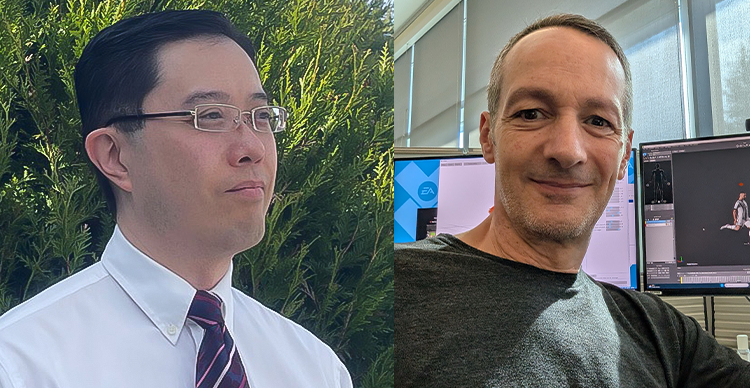 VFS 3D Animation alumni Fonda Louie and Paul Baruzzi were Senior Animators on FC26
GET TO KNOW PAUL BARUZZI AND FONDA LOUIE
A graduate of Vancouver Film School’s 3D Animation & Visual Effects program, Paul Baruzzi has been with Electronic Arts for over two decades! He’s been with the FIFA/FC team the entire time, working as an animator on virtually every installment in the series since FIFA 14.
On FC26, Paul owned all Passing and Shooting animations – from design to motion capture, clean-up, import, and more. He also served as the Mocap Manager, planning all mocap shoots, booking talent, and setting animation priorities & the shooting schedule.
Another alum of the 3D Animation & VFX program at VFS, Fonda Louie has been with EA nearly 14 years, working his way up from Associate Animator to Senior Animator.
Fonda’s focus on FC has primarily been Game Play animation, and he’s currently responsible for NPC and Crowd animation on The Grounds – the game’s open world mode.
If animating for video games sounds like your dream job, VFS’s 3D Animation & Visual Effects program gets you fully trained and equipped with the skills and portfolio needed to pursue a career in the industry. From character animation and modeling to lighting, effects, and production workflows, you’ll build an industry-ready skill set through collaborative, project-based learning – all in just 1 year.
OUR Q&A WITH TWO SENIOR ANIMATORS
What are some of the unique challenges of animating for a game like FC26, and how did you and the team approach them?
PB: Our biggest challenge is balancing responsiveness with visual targets. We could achieve much more fluid and authentic animations in game, but that would come at the cost of responsiveness. To hit our response targets, we need quicker animations, with shorter wind-ups and branch-outs.
Playing a lot of quick animations can make the game look messy, even if it does achieve our responsiveness targets. Using PTM or Matchmaking can allow us to play quick animations but only branch out to poses that hit a matching threshold, reducing poor blends and animation popping.
FL: Animation on such an in-depth game such as FC26 is all about compromise between many competing priorities. All under the limitations of console memory. Responsiveness vs. smooth animation, greater variety vs. polish, authentic realism vs. predictable results.
Animators produce visuals with artistic interpretations while being open to the team’s feedback, good or bad. It takes contributions of an entire team to make a game FUN.
Was there a particular animation, sequence, challenge or moment during production that stands out to you? What made it memorable?
FL: Our game is populated with mocap data. Mocap data is good, clean and we can shoot exactly what we want. However, mocap data is not game intensive. Real life games are at full speed, full effort, and very reactionary. Mocap can be an 8-hour day, but we can’t get intensive performances all day. We also don’t get the reactionary movement. In real life they react in real time to what is happening, We don’t get that in mocap as they always know their movements before the take is recorded.
This year we used some Volumetric data, from real life games in the EPL. The intense motion and player speed are unmatched in mocap. We also have a variety of kicks that are imperfect, jostled, reaching, or falling/sliding afterwards, which happens a lot in real life, but isn’t easy to fake in mocap. This data is not as clean as mocap, so it takes longer to get into game quality, but the difference motion we get from Volumetric has brought an authentic and competitive feel that mocap couldn’t achieve.
FL: What was memorable was development of new animation techniques to work with new tech. A feature required the teaming of an artist with a Software engineer. People from different disciplines, art vs. tech made collaboration difficult. There was plenty of back and forth to trying to explain visuals while trying to understand the underlying tech. After many tests and we were able to produce techniques the world has not seen.
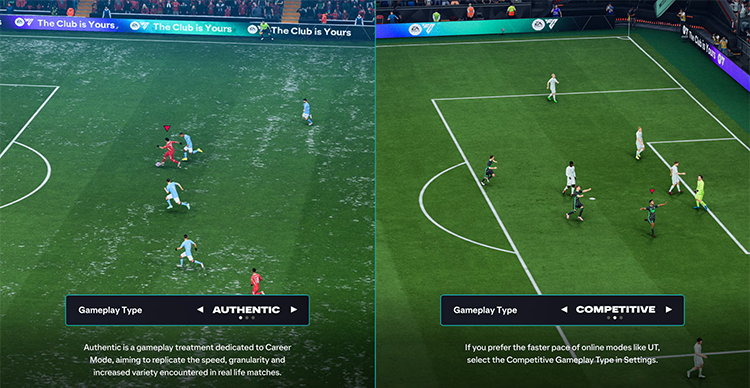 A side-by-side look at FC26’s Authentic and Competitive modes.
Looking back at your career so far, what skills or lessons from your time at Vancouver Film School have stayed with you and continue to influence your work?
PB: I knew nothing about Animation before attending VFS, so everything I learned at VFS has helped shape me and my animation skills. Something very simple I can recall learning in class that I still use to this day is the benefit of strong posing. If this pose was only an alpha channel, would it still look as strong? That is something I ask myself and coworkers often still to this day as we review animations.
VFS gives you a great opportunity to learn new skills and make all the decisions about your demo, but the most important part after school is how you work as a teammate. The group projects at VFS were much more representative of real-world roles. Although not as enjoyable, it taught how to work with others, with deadlines.
FL: The same attitudes that make for a successful student are the same to be successful in the industry. Truly listen and consider feedback. Having a narrow focus on your “vision”, will blind you to improvements on your work.
What was the transition like from studying animation to working professionally in the games industry, and what do you wish you had known when you were a VFS student?
PB: My transition was seamless. Mostly because I was going to a game that featured ‘soccer’ motion, and I was very confident in my animation skills, and my knowledge of soccer posing. This was where I wanted to end up when I started at VFS, so it felt natural. My time at VFS was focused on Animation. I got a little push back when my modeling or tech skills were not up to par, but I wanted to focus only on my animation, and human movement.
FL: The animation curriculum will give exposure to many disciplines and allows a student to direct their own vision. Working in the industry means using your skills towards a single vision of the project. Working in a large project/organization it is generally expected to specialize in all aspects of a single discipline. Smaller organization will have some generalists.
Game animation is constantly evolving alongside new tools, technologies and workflows. From your perspective, what skills or qualities are most important for an animator who wants to build a long-term career in games today?
PB: It will always be important to have strong Animation Principal Skills, and a good sense of human movement and performance. However, as an animator I also spend a lot of time in the Animation Databases, changing blend times, codecs, contact timing or branch outs which can all effect how an animation feels and looks. Our Animator job openings now will always ask for some Tech skills. Expressions, scripts, rigging, motion-matching or a good knowledge of how to use AI to improve your productivity and workflow.
FL: Get some experience with integration of animation into a game engine. FC Animation is a fairly technical role. Animators are responsible for integrating and testing their own animation features in game.
For students and emerging animators who hope to work on major games like FC26, what advice would you give them as they build their skills, portfolios and careers?
PB: First is to try and do something you will enjoy. The more you enjoy the creation of your animations, the more you’ll want to do the extra work, take time to experiment and iterate, improve your craft, all while feeling like a hobby rather than work. That will ultimately make you a more valuable teammate.
Take pride in every animation you get to make. When I replace or refresh specific in-game animations, I am sometimes replacing animations that have been in game for upwards of 10 years. That also means what I am putting into game could be there for the next 10 years. Taking extra time to ensure small details are polished, the arc of a foot kicking, the secondary movement of the wrists, or the head and neck looking aware of surroundings with real life game intensity. Take pride in your animations and it will be noticed.
This industry is always changing, which can create opportunities for new hires. New tech can open up new roles for people to own. We are slowly moving from mocap to Volumetric data, which required people to become experts on solving that type of Meta data. How do we store it? How can we make it searchable? Or how do we use AI to help us solve and categorize millions of frames of meta data, saving the animators months of ‘first pass’ cleanup time. These may seem like SE questions, but for us, these are Animator tasks, and these are opportunities for Animators to own gameplay areas and improve their value to the team and company.
FAQ
1. Who were the alumni that worked on FC26, and what were their roles?
- Josh Anaya-Paiero – Virtual Camera Assistant
- Eric Choi – Senior Animator
- Paul Parsons – Lead Producer
- Xavier Lucente – Audio Artist
- Jon Fish – Senior Audio Artist
- Ciara Petti – HMC Operator
- Luis Fernando Arvizu – Associate Quality Designer
- Austin Rae – Experience Designer
- Stephanie Cheung – Associate Quality Designer
- Delaney Leatherdale – Producer
- Gordan Niemann – Software Engineer
- Michael Enderby – Technical Artist
- Caylie Williams – Associate Quality Designer
- Tim Dale – Quality Designer
- Brendan Douglas – Producer
- Adam Barnett – Senior Art Director
- Adam Bucifal – Technical Artist
- Simon Jenkins – Principal Director
- Nigel Nunn – Acquisition Craft Director
- Daniel Contreras – Game Designer
- Kareem Batin – Mocap Assistant
- Alon Mizrahi – Software Engineer
- Henson Tan – Senior Technical Artist
- Bernie Lopez – Associate Quality Designer
- Alex Gramm – GO Release Manager
- Fonda Louie – Senior Animator
- Sephine Kuan Cruz – Environment Director
- Bhavesh Gupta – Software Engineer
- Luke Shier – Animation Director
- Angella King – Senior Animator
- Stan Siebert – Environment Artist
- Alicia Morote – Associate Quality Designer
- Eduardo Ramirez Montiel – Animator
- Paul Baruzzi – Senior Animator
- Corey Kleim – Environment Director
- Lizz Seo – Senior Environment Artist
- Laszlo Pollak – Game Designer
- Gopal Reghunath – Character Artist
- Kirk Takei – Senior Lighting Artist
- Jethro Aquino – Lead Experience Designer
- Kelsey Armour – Experience Designer
- Juan Daniel Vargas Luque – Game Designer
- Tim Quinn – Associate Quality Designer
- Larry Wang – Technical Art Director
- Rajan Beryar – Producer
- Patrick Lee – Audio Artist
- Eunice Lo – Environment Artist
- Jason Kurtz – Art Director
- Steve Froste – Quality Designer
- Jamie Dykeman – Facial Animation Lead
- Jamie Moon – Experience Designer
- Craig Koehn – Senior Animation Director
- Genevieve King – Head of Create
- Randall Barilea – Senior Game Designer
- Kristjan Jakobs – Audio Artist
- Jason Riles – Development Manager
- Lorelei Saez Co – Senior Environment Artist
- Ali Nava – Technical Artist
- Danny Lee – Senior Experience Designer
- Michael Chambers – Audio Artist
- David Valdez – Technical Interface Designer
- Tristan Beulah – Technical Art Director
- Azlan Mustapha – Lead Producer
- Eric Young – Senior Technical Product Manager
- Matthew Thomas – Senior Technical Artist
- Carson Steinmann – Associate Quality Designer
- Edward Li – Creative Technologies Development Manager
- Leo Schiffer – Audio Producer
- Brian Bredonia – Cinematic Designer
- Xiyu Zhang – Lighting Artist
- Alper Zini – Associate Quality Designer
- George Wu – Senior Software Engineer
- Federico Rahal – Principal Technical Art Director
- Kaleb Valenzuela – Software Engineer
- Elias Issa – Technical Artist
- Kush Mathur – Producer
- Leonardo Chiasso – Technical Artist
- Ellaya Zampieri – Technical Artist
- Thomas Caleffi Scaletscky – Producer
- Victoria Canning – Capture Production Assistant
- Shayan Eftekhari – Producer
- Joe Andronyk – Senior Technical Artist
- James Ricker – Senior Director, Creators
- Xiaochun Lyu – Technical Artist
- Sergio Leon – Character Artist
- Miya Huang – Environment Artist
- Fred Simpson – Art Director
- Jon Rohland – Senior Technical Artist
- Tyler Brown – Senior Quality Designer
- Sam Zhao – Character Artist
- Alvin Guo – Environment Artist
- Denny Lau – Senior Animator
- Victor Casco – Game Tester
2. What Vancouver Film School programs did the alumni graduate from?
- Film Production
- Writing for Film, Television & Games
- Makeup Design for Film & Television
- Sound Design for Visual Media
- 3D Animation & Visual Effects
- Classical Animation
- Animation Concept Art
- Game Design
- Programming for Games, Web & Mobile
- Digital Design
- Foundation Visual Art & Design