
Illustration is the creation of an image to explain, interpret, communicate, or visually support an idea, story, subject, or message. An illustration can be drawn, painted, collaged, photographed, rendered digitally, or created in 3D. Unlike “drawing,” which often describes how an image is made, “illustration” primarily describes what the image is intended to do.
Illustration is image-making with a job to do. Sometimes that job is obvious: show a scene from a children's book, explain how a machine works, or create an image for an advertising campaign. Other assignments are less literal. An editorial illustrator might have to turn an abstract argument into a single image. A concept artist may be figuring out what a character or environment should look like before anyone builds it.
The image itself can be made in pencil, watercolor, vector software, Photoshop, 3D, collage, or a mix of methods. So the material doesn't tell you whether something is an illustration. Purpose does much more of that work.
A useful starting question is: What does this image need to communicate, and who needs to understand it?
What Makes an Image an Illustration?
Take two watercolor paintings of the same bird. The first artist paints one while studying birds at home. There is no assignment and no intended use beyond the study itself.
The second artist receives a commission for an educational field guide. The species has to be recognizable to readers, which means particular markings, proportions, and colours can't simply be changed because they make for a prettier composition.
Visually, the two paintings might be very close. Their context isn't. The second artist is solving a communication problem.
That distinction is useful because the phrase “illustration is a drawing” falls apart fairly quickly. Many illustrations are drawings, but illustration can also be painted, collaged, rendered digitally, modelled in 3D, or produced through mixed media.
Instead, look at the situation around the image. What is it meant to show or communicate? Who will see it? Where will they see it? Are there things the image has to make clear?
Those questions often tell you more than the software or medium. And the boundaries are not perfect. They don't need to be. Creative disciplines overlap constantly.
How Can You Tell if an Illustration Works?
Artists can spend hours polishing an image that has a more basic problem underneath.
Maybe the character is rendered beautifully, but you barely notice them against the background. Maybe a detailed image looks impressive at full size and turns into visual mush once it appears as a thumbnail. Or the viewer simply reads the scene differently from the way the artist intended.
When that happens, adding detail usually isn't the answer. It helps to look at the image against the job it has to do.
| What to check | What you're really asking |
|---|---|
| Goal | What does the viewer need to understand, notice, or feel? |
| Readability | Can someone who knows nothing about the project make sense of the image? |
| Focal point | Where does the eye land first? Is that where it should land? |
| Composition | Are the shapes, values, scale, and placement helping the main idea? |
| Audience | Does the image make sense for the people who will actually see it? |
| Context | Does the approach suit the book, article, product, game, or other setting around it? |
| Final format | Does the image still work at the size and resolution where it will be used? |
None of those tests asks whether the image is “good art” in some universal sense. They're more practical than that.
Consider an illustration for a children's book. If the page is about a child hiding under a table but the room itself dominates the composition, the problem may be visual hierarchy. Moving the child, simplifying the background, or changing the values could solve more than another hour of rendering ever would.
That's illustration as problem-solving rather than decoration.
Illustration, Drawing, Graphic Design and Concept Art Aren't the Same Thing
These fields borrow from each other so often that a strict visual test doesn't work very well. A concept artist can create a highly polished painting. A graphic designer may draw. An illustrator may work with typography. A fine artist may take commissions.
It makes more sense to look at the main task.
| Discipline | What the work is primarily doing |
|---|---|
| Drawing | Creating visual form through marks, lines, shapes, value, and related techniques |
| Illustration | Using imagery to communicate or interpret an idea, subject, story, or message |
| Fine Art | Pursuing broader artistic expression, investigation, or self-directed work |
| Graphic Design | Organizing visual elements into a communication system |
| Concept Art | Exploring and solving visual ideas that guide later production |
Is an illustration a drawing?
Sometimes. A life-drawing study can simply be a drawing. Put that same skill to work on a commissioned newspaper image, story scene, or instructional diagram and the result may be an illustration.
“Drawing” tells you a lot about how an image was made. “Illustration” tells you more about why it exists.
What does illustration mean in art?
In an art context, illustration usually refers to an image connected to something beyond the image itself: a brief, story, subject, message, publication, product, or intended audience.
That doesn't make illustration uncreative. Far from it.
A brief such as “show a lonely person in a crowded city” leaves an illustrator with dozens of choices. Which person? What viewpoint? How crowded is crowded? Is the character tiny in the frame, squeezed between other people, or isolated by colour even though people surround them?
The assignment creates limits. The creative work happens inside them.
What is illustration in graphic design?
Graphic design and illustration often meet in the same piece of work.
Picture a magazine cover. The illustrator may create the central image while the designer works out the masthead, typography, hierarchy, cover lines, spacing, and the relationship between those elements.
Of course, one person can do both. What matters here is the task. Illustration develops the image; graphic design often works with the larger system that the image has to live inside.
Illustration vs. concept art
This is one of the easier distinctions to miss because the finished images can look remarkably similar. Concept art often comes earlier.
A concept artist might be asked to explore several versions of a character, decide how a vehicle works, or establish the visual language of an environment before another artist models, animates, or builds it.
The first audience may be a director or production team rather than the public. Illustration is more often the image that the intended audience will encounter directly.
Even that distinction has exceptions, but one question clears up a lot of confusion: Is this image the finished visual communication, or is it helping a production team decide what something should become?
Types of Illustration: Start With the Purpose
Lists of “illustration types” get messy fast. Watercolor, editorial illustration, vector art, children's books, 3D, advertising, concept art — put all of those into one list and you're mixing methods, industries, and purposes.
It's easier to separate them.
What is the image for?
| Purpose | Where you might see it |
|---|---|
| Narrative illustration | Picture books, comics, graphic stories |
| Editorial illustration | Articles, essays, journalism, opinion |
| Commercial illustration | Advertising, packaging, brand campaigns |
| Explanatory illustration | Scientific, technical, educational, instructional material |
| Entertainment and development imagery | Film, animation, games, characters, environments, keyframes |
The demands change with the assignment.
An editorial piece may need a visual metaphor rather than a literal picture of what the article says. Technical illustration has less room for ambiguity when a reader needs accurate information. Narrative work brings other questions: which moment deserves an image, what happens just outside the frame, and what should the viewer understand about the characters before reading another word?
How was it made?
That's a separate question.
An artist may work with pencil, ink, paint, raster-based digital tools, vectors, 3D, collage, or combinations of them. The same editorial brief could plausibly be solved with watercolor or a flat vector image. Neither choice makes the work more or less legitimate as illustration.
The method affects the look and the workflow. It doesn't decide the purpose.
Style Matters. It Just Isn't the Starting Point.
“Finding your style” gets a lot of attention among developing artists, sometimes so much that it starts to sound like style is the thing holding everything else together.
Usually it isn't. Imagine five illustrators working from the same brief. One uses loose ink. Another paints carefully rendered figures. Someone else works with flat geometric shapes. All three approaches could be right for the project. Or wrong.
A style can be attractive and still fight the assignment.
When an image feels off, it is worth checking the underlying decisions before deciding that the whole style needs to change. Is the focal point weak? Are the proportions wrong? Does the value structure flatten everything together? Did you simplify the one feature the viewer needed to recognize the subject?
Those are different problems. Style is how the artist translates the idea. It can't rescue an image when the translation itself is unclear.
How an Illustrator Gets From an Idea to a Finished Image
The polished image is the part everyone sees. Quite a lot happens before that.
A brief comes first, at least in professional work. It may be loose or painfully specific. Either way, the illustrator has to figure out what matters: the audience, the intended use, required elements, dimensions, deadline, and the thing the viewer is ultimately supposed to understand.
Then comes research. If the image involves a historical street, a particular animal, unfamiliar clothing, machinery, architecture, or a believable human pose, reference helps. An illustrator might collect far more material than appears in the final image. That's normal. Research gives you something solid to make choices from.
The next stage is often rough.Thumbnails are useful precisely because they're rough. You can try a close-up, pull the camera back, move the figure to one side, change the scale, test a silhouette, throw the whole thing away and start again — without losing half a day.
This is also where a lot of the real illustration work happens. Which moment tells the story best? What needs to be visible? What can disappear? If the image has one second to grab attention, where should the eye go?
Once a direction seems promising, the artist develops it. Perspective becomes more accurate. Shapes get resolved. Colour, lighting and value begin doing more deliberate work.
Then somebody looks at it. That part is easy to understate. Critique is often where an image stops being “the thing I've been staring at for six hours” and becomes something another person has to understand.
A useful critique is specific. “The image feels wrong” doesn't offer much. “The character's face is important, but the window behind them has the strongest contrast in the whole image” gives the artist something to work with.
And sometimes the answer isn't a small correction. You may have to return to an earlier thumbnail, change the camera angle, simplify half the scene, or scrap a version you were already attached to.
That's why the process is better pictured as a loop than a straight line. You try something. Test it. Change it. Occasionally you go backwards.
Eventually the image has to leave the studio, which creates another reality check. Does the poster still read from several metres away? Does the illustration work after the layout designer puts type over part of it? What happens when a large painting becomes a small image on a phone?
A finished illustration has to survive its real use, not just look good at 200% zoom on the artist's monitor.
CASE STUDY: From Concept to Finished Illustration
Project by: Natchawadee Duangrat (Gigi)
Program: Animation Concept Art, Term 6
Project: Final Project Assignment
Creating an impactful illustration isn't just about producing a visually striking image. Every choice - from camera angle and composition to colour and value - can shape how an audience understands a story moment.
For her final project, VFS student Natchawadee Duangrat (Gigi) was tasked with developing an impactful story moment based on her final project narrative. The moment she chose was the revelation of the main villain Fatihka's secret, with the goal of communicating stress, fear, intimidation, and suspense.
Exploring the Story Moment
Gigi began with a series of thumbnail explorations, testing different compositions and camera angles to determine how best to communicate the tension between the characters.
Of the initial options, the third thumbnail stood out as the most emotionally effective. The closer framing allowed the audience to connect with the characters more directly, while the wider compositions made their faces too small to clearly read their emotions.
Based on this feedback, Gigi revised the selected thumbnail with a colour pass, enhancing the details and pushing the values to create stronger contrast and clarity.
Establishing the Power Dynamic
The revised image was working, but another storytelling challenge emerged: both characters appeared to have a similar level of importance within the composition.
To establish Fatihka as the imposing threat in the scene, Gigi was encouraged to adjust the camera so the villain's face could be seen more clearly in a close-up, three-quarter view. Moving away from a side profile added depth and gave the audience a stronger view of her expression and intentions.
Colour and value also became important tools for separating the characters and strengthening the composition. Some areas had become muddy and began to blend together, making shapes - including the character's elbow and torso - more difficult to read. Brighter tones were introduced in key areas of interest, while clearer distinctions between warm and cool tones helped separate the foreground, middle ground, and background.
The Final Image
In the final revision, Gigi rotated Fatihka's face toward the camera and placed the characters in a three-quarter angle, creating greater depth and making the villain's expression easier to read. She also cleaned up the colour and value structure and added clearer linework to define the forms.
The changes significantly altered the storytelling power of the image.
Fatihka now occupies more visual space in the frame, immediately establishing her as the dominant figure. Her elevated head position compared with the other character reinforces the power imbalance, while the other character's lower position makes him appear more vulnerable and oppressed.
The colour palette reinforces that dynamic. Red tones heighten the feeling of rage and tension around the villain, contrasting with the cooler tones in the background. The result is an atmosphere that feels tense and uninviting, while overlapping elements throughout the composition create additional depth.
Most importantly, the revised composition makes the story moment easier to understand at a glance. The audience can clearly identify what is happening, who is in control, and where they should look first.
Through the iterative process of thumbnail exploration, feedback, revision, and refinement, Gigi was able to translate the true intentions of her narrative into a clearer and more impactful visual story.
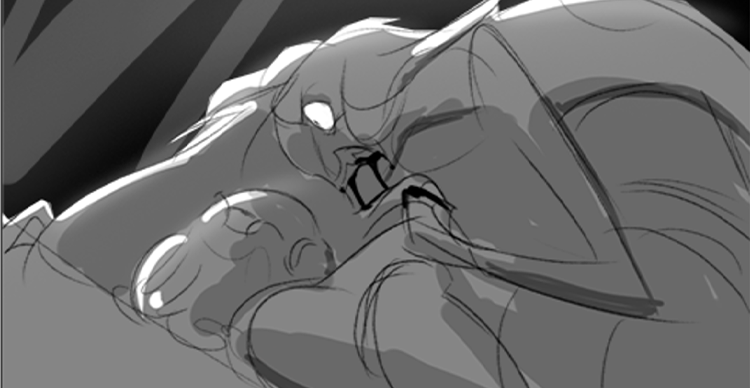 A look at the ‘before’ and ‘after’ of Gigi’s final project from VFS’s Animation Concept Art program.
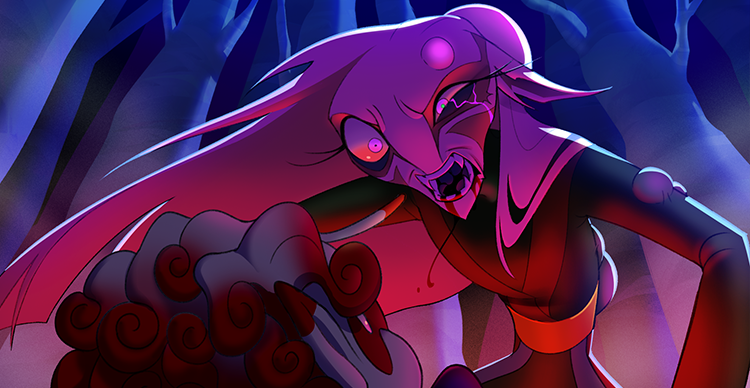 A look at the ‘before’ and ‘after’ of Gigi’s final project from VFS’s Animation Concept Art program.
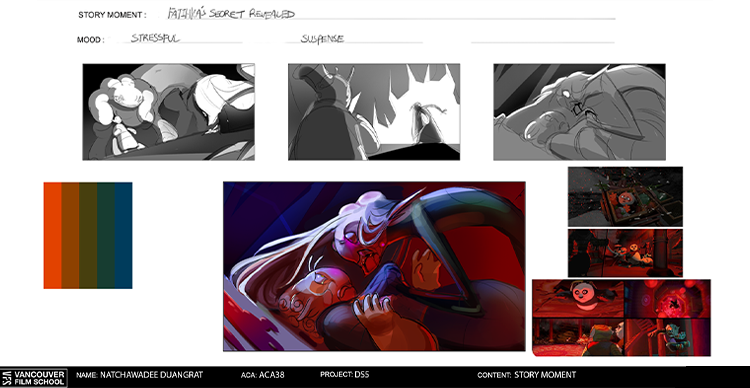 A look at the ‘before’ and ‘after’ of Gigi’s final project from VFS’s Animation Concept Art program.
From Illustration to Animation Concept Art at VFS
Illustration and concept art share a lot of ground. Composition, perspective, shape, colour, visual storytelling and digital painting all travel between the two. The difference is where those skills get used.
Vancouver Film School's Animation Concept Art diploma is a 12-month program built around design, drawing, digital painting, visual storytelling and portfolio production. Students develop design packages for props and vehicles, environments and characters rather than working toward only one type of finished image.
The curriculum gets quite specific about the underlying craft: composition, shape, line, silhouette, traditional and digital workflows, perspective, value and colour all appear in the program material.
There is an iterative side to the training as well. Later stages include mentor critique, instructor dailies, revision and refinement while students build their final portfolios and design packages.
That helps explain the connection between illustration and concept art. An illustrator may be solving the final image. A concept artist may use many of the same abilities to solve what a character, prop or environment should become before production moves forward.
Career paths include Concept Artist, Character Designer, Storyboard Artist, Digital Illustrator, Book Illustrator, Comic Illustrator, Visual Development Artist, Keyframe Illustrator and Digital Painter.