
Key Takeaways
- The Silence After became the fifth VFS student game to win a Unity Award, recognized for its innovative sound-to-colour gameplay mechanic.
- The award-winning horror game was developed by VFS Game Design students as a multidisciplinary final project spanning art, design, programming, and sound.
- The project reflects real-world studio production, from managing scope and iteration to extensive playtesting and final polish.
Last December, The Silence After became the FIFTH game made by VFS students to win the Unity Award for Best Student Game. 8 total games were nominated – including two other VFS games, Incorporeal and Train Wreck – showcasing the incredible talents of emerging game devs from around the world
This week, we chatted with the game devs who brought The Silence After to life during their time as Game Design students at Vancouver Film School. Keep reading to learn more about the game’s development, their experience at VFS, and more.
ALL ABOUT ‘THE SILENCE AFTER’ (AND THE TALENTED GAME DEV TEAM)
The Silence After is a first-person atmospheric horror game set in an apocalyptic reality. You play as a blind sole survivor following a distress signal, interacting with the environment and using a synesthetic ability to perceive sound as colour to progress and avoid death.
The game was developed by 6 VFS students as part of their final project in the Game Design program: Dominic Hayes (Character Artist/Environment Artist), Henry Broestl (Level Designer/Sound Design), Iván Plouganou (Project Manager/UI UX Design), Jasper Chao (Technical Designer/Systems Design), Jordan Bzdel (Sound Designer/Project Manager), Pasha Stierle (AI Programmer/Tech Artist), with Voice Acting performed by Rebecca Wass.
What’s most remarkable about the game is its distinct look. Unlike more traditional games, where you might see the all of the environment around you as you progress, The Silence After plunges you into darkness. While your ability allows you to reveal parts of the environment, much of it remains hidden in shadow. At times, it feels as if the you’re playing on a piece of carbon paper – the environment traces of some larger picture that will never be fully clear.
ABOUT VFS’S AWARD-WINNING GAME DESIGN PROGRAM
Vancouver Film School is ranked the #1 Game Design School in Canada by The Princeton Review. Students specialize in their choice of Coding, Game Art, or Level Design as they work towards developing a polished, retail-ready game for their portfolio – proof to studios that they’re industry ready.
VFS Game Design students also have access to exclusive software, tech, and more with top-tier industry partners, including Epic/Unreal Engine, ASUS, and Beyond Capture Studios, a professional motion capture volume located right on VFS’s campus.
If you’re an aspiring game dev looking to be trained for the growing game industry, book an appointment with a VFS Advisor to discuss start dates, tuition, and scholarship opportunities.
OUR Q&A WITH THE UNITY AWARD-WINNING TEAM BEHIND ‘THE SILENCE AFTER’
Congratulations on your big win! What was your initial reaction when you found out you’d won?
Honestly, it was an honour just to be nominated alongside so many strong projects, including Incorporeal and Trainwreck from VFS. There were also impressive submissions from other schools like, Breaking News and Rephobia, showcasing some real clever and innovative ideas from students, worldwide. But when they announced us as the winners, we were genuinely shocked and thrilled. We watched the livestream together as a team, and I’m pretty sure I blew out my mic yelling in excitement.
Where did the original concept for The Silence After come from? How did it evolve?
We basically locked ourselves in a room for several days while drawing thousands of lines onto a whiteboard coming up with over 30 ideas before narrowing them down. From the start, we wanted a mechanic that fundamentally changed how players interact with the world. Something we hadn’t seen before and would challenge us creatively. We gravitated toward horror and focused on what makes it effective: the unknown, darkness, and sound.
That led us to ask how do you navigate in a world where the player can’t see? How do you use sound and how do you utilize it as a mechanic? How do you show any of this? Then the idea of synesthesia came along. At first, we used LIDAR as a reference along with properties of sound waves. Then we did our own research into synesthesia along with talking to others that have this ability. All of this information really helped shape and form what the game came to be.
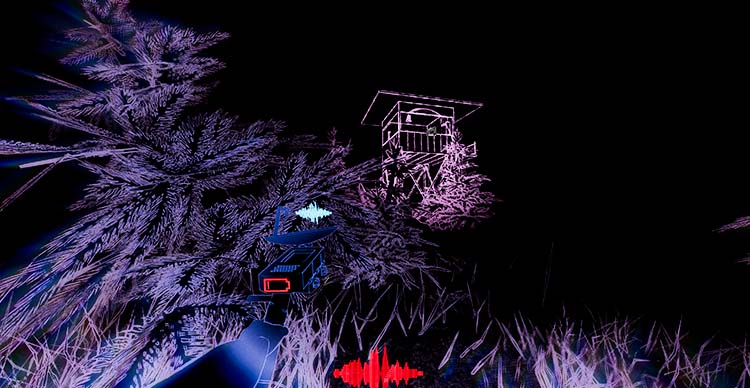 Official art from Unity Award-winning game The Silence After – developed by 6 VFS Game Design students.
What was the biggest challenge you faced in development?
Managing scope was a huge challenge. You often start with ambitious ideas, only to realize how much time, skill, and iterations they require. Horror made this especially difficult, as for much of development the game world was simple geometry and placeholder assets that initially weren’t intimidating or scary at all. It wasn’t until the final stretch of polish that the game truly came together.
We had to cut many ideas, monsters, biomes, tools, and cinematic moments, which forced us to focus on the core experience. Plus the general ups and downs of game development, where after a big milestone you don’t even know if the game works. However, figuring out how to give information in a game built around the lack of information was one of the toughest problems we tackled. It took countless playtests and adjustments to nail down.
How pivotal was your VFS education in helping you make this game?
Having instructors and mentors on site was invaluable. We were never left feeling on our own, and we were constantly learning and applying new skills in real time. HUGE shoutout to Quinn Henshaw. Incredible teacher and a programming wizard with unbridled patience to deal with our torrent of programming questions. Mentors like Cassio, Alan, Yuen, and Rasmus (and many more) were instrumental in helping us solve complex design problems while offering insight into the game industry. VFS’s production floor also fostered a true studio environment, giving us space to work professionally while still enjoying the process.
What’s coming next in your careers?
Since graduating, some of us have started working in the game industry, while others have participated in game jams and continued developing other projects. We remain as a close-knit group of friends and without giving too much away, this is not the last you’ll hear of The Silence After.
What advice would you give to aspiring game designers?
Strong communication and mutual respect within a team are essential. Learning how to filter feedback is equally important. Understanding why players feel a certain way without treating every opinion as fact. Know your core pillars and don’t be afraid to iterate or pivot when needed. Manage your scope and remember that a mountain of ideas can be chiseled down into something great. Most importantly, don’t lose your passion and believe in what you are creating. Game development is incredibly difficult, but I can't think of anything more rewarding.