
Key Takeaways
- Vancouver Film School Writing alumni Lucia Frangione and Brenna Kwon have been selected for Pacific Screenwriting Program’s highly competitive 2026 Scripted Series Lab.
- The professional development lab connects emerging TV writers with industry showrunners, writers’ rooms, and career-shaping mentorship.
- VFS’s Writing for Film, Television & Games program prepares graduates with portfolio-ready scripts and industry collaboration skills.
Exciting (and huge!) news for two VFS Writing for Film, Television & Games alumni! Lucia Frangione and Brenna Kwon have been selected for Pacific Screenwriting Program’s 2026 Scripted Series Lab and are about to embark on a once-in-a-lifetime career-advancement journey.
Over this 15-week program starting this January, Lucia and Brenna will have an unparalleled opportunity to enhance their skill sets while refining & perfecting their winning original TV concepts alongside acclaimed industry writer Floyd Kane (Continuum, Slasher, creator of Diggstown).
ABOUT PACIFIC SCREENWRITING PROGRAM’S SCRIPTED SERIES LAB
Based right here in Vancouver, Pacific Screenwriting Program is a professional development initiative designed to support emerging and mid-career screenwriters working in television. Launched in 2016, the lab was created in response to the rapid growth of scripted series production in Canada and the increasing demand for writers who can develop compelling, production-ready episodic stories.
Each year, a small cohort of writers is chosen through a competitive national process, with participants selected for the originality of their voices and the strength of their series concepts. Once accepted, writers take part in an intensive, multi-week development process that mirrors professional TV writer’s rooms, offering rare access to industry-level mentorship and hands-on story development.
The Scripted Series Lab exists to bridge the gap between emerging talent and the professional television industry. Participants receive in-depth feedback from experienced showrunners, story editors, and producers, while refining their series bibles, pilots, and long-term story arcs. Beyond craft, the program emphasizes collaboration, pitching, and career sustainability, key skills needed to succeed in today’s competitive TV landscape.
By nurturing bold, original voices and preparing writers for real-world production environments, the Pacific Screenwriting Program has become an important launchpad for Canadian screenwriters, helping position them and their projects for success in the scripted television market.
ABOUT VFS’S WRITING FOR FILM, TELEVISION & GAMES PROGRAM
Vancouver Film School’s Writing program trains multi-disciplined writers hands-on in a true studio environment to create a powerful production portfolio (the ultimate industry calling card) – all in just 1 year. Students specialize in their choice of Film, Television, or Games, learning from active industry writers, and collaborate with VFS Film Production, and Acting for Film & Television students.
By the time you graduate, you’ll have amassed an incredible portfolio of long-form samples that includes features, TV specs, and game design docs – depending on which stream you choose to specialize in.
VFS’s Writing program has created artists that have worked on Tron: Ares, House of the Dragon, Final Destination: Bloodlines, Andor, Game Awards-nominee Ghost of Yōtei, and more. If you’re an aspiring writer looking for accelerated industry training, visit our official Writing program page to learn more about the program, start dates, tuition, and to apply.
 Pacific Screenwriting Program’s Scripted Series Lab is a 15-week program designed to equip writers with the skills needed to succeed in television.
OUR Q&A WITH VFS WRITING ALUMNI LUCIA FRANGIONE AND BRENNA KWON
We were fortunate to chat with both Lucia and Brenna on this exciting professional development opportunity, their time as VFS Writing students, and more:
Congratulations on being accepted into Pacific Screenwriting Program’s Scripted Lab Series! What was your reaction when you received the news?
LF: Thank you! When Smita called me, I was walking my dog down a quiet leafy lane on Bowen Island where I live. I hooted so loud with joy, I startled my dog. I had submitted in the past, to no avail, so I was chuffed to be accepted this time, especially because I have such high regard for the showrunner, Floyd Kane.
BK: I felt a mix of surprise, gratitude, and exhilaration when I received the news. This was my second time applying to the Scripted Series Lab, and the initial rejection ultimately invigorated me. It pushed me to refine my work and persevere, rather than treat the experience as discouragement. Having that sustained effort and ambition culminate in a “Yes” instead of another “No” was deeply affirming. It felt like meaningful encouragement and a gentle but motivating push as I continue to cultivate my career as a writer.
Can you tell us about the project you submitted?
LF: I submitted a one-hour drama with procedural elements, Women of Fire (terrible title!). I was inspired by my friend, Izzy: one of the first female firefighters in BC. She smashed all sexist assumptions and ended up being a highly respected and loved captain. Still, to this day, only 5% of the IAFF are female identifying.
My first season focuses on the lives of crew members at Hall 12, in the fictional Sitka Valley. Natalie Buscema is a firefighter in her early fifties who holds on to her sobriety by a thread, having suffered PTSD from a string of hard calls. Back in the 90s, she had enrolled with her best friend, Ceci Crudo, who is now a successful chief. Crudo’s entire identity is wrapped up in her job and she dreads retirement.
A rookie joins Buscema’s crew, Maxine Tam, former diver for the RCMP. She’s gone into fire for the pension and the benefits, expecting a baby with her wife. Her captain, Jerry Potts, assumes she’s a diversity hire. Jerry is an old school bully but a shrewd captain. He loves his sons and he’s afraid of losing his family. The crew is rounded out with Ronnie Allard. He’s a young father of three who comes from a tight knit Filipino family. His wife lives with MS. His culture and his faith do a lot to sustain him.
Each episode follows this crew on their calls and how they navigate potential trauma, workplace stressors, and work/home transition. First responders have a high rate of substance abuse, divorce, and suicide. The women in the Sitka Valley fire department end up forming a support network, like my friend Izzy and her colleagues did.
BK: The project I submitted was a TV pilot I originally developed at VFS, with the support of mentors who helped me critically edit and tailor the work for industry exposure and future competitions. The project is titled Taxidermied Youth, and it is set in the backdrop of the year 1960 in an elite school for girls located in a Japanese colony that capitalizes on the colonized Korean teens’ bodies as luxury fashion items and home decor. An innocent but precocious tween searches for her missing parents while trying to outwit her teachers (i.e., captors) – especially the manipulative headmistress – before she is groomed and chosen for harvesting.
When she finds out that her best friend is next in line to get taxidermied, the girls – with sisterhood and solidarity – struggle to formulate an escape plan before the ultimate culling. The comps would be a mix of Never Let Me Go (2010) and The Man in the High Castle (2015).
When asked, "What inspired you to write your project, Taxidermied Youth?" I would like to mention family. The project is set in 1960s Korea, and despite its alternate-historical setting, I derived many elements from the real historical experiences of my grandparents. Their real-life experiences and my desire to retell those stories under a fictional lens align with what's at the core of my writing, which is utilizing writing as an act of resistance for those victimized in history.
Can you describe your experience in VFS’s Writing program?
LF: Kat Montagu wooed me into the program over a cup of tea. I was going to go into production, but she encouraged me to investigate the Writing program. Her logic won me over: I should focus on what I do best and I can hire the rest. I was grateful to receive a scholarship. Though I had already worked as a professional writer in other mediums for over thirty years, I learned so much from my instructors at VFS. Writing for film, TV, and games and navigating the business side of things is completely different from theatre.
I was challenged, humbled and invigorated by my instructors at VFS. They are all working writers with impressive resumes and they have a real love and passion for the craft that shines through. I went into the TV stream and Ita Margalit and Laura Doyle were a great encouragement to me. I must also mention Rick Drew and Keith Shaw who both went above and beyond to help me with letters of support and script feedback. It was such a luxury to immerse myself in learning, night and day, and to have materials prepared for me. Most of my education, like a lot of writers, has been autodidactic. Post-graduation, I’ve co-written scripts with cohorts Jack Mardon and Michel C. Esslemont, and wrote and produced a short film with Angelika Padberg directing and Max Ehlbeck as first AD.
BK: Before VFS, I had minimal experience in screenwriting, so the Writing program was both foundational and essential in helping me get my feet wet and fully immerse myself in the craft. VFS also allowed me to build a strong network of peers and alumni, not only fellow writers, but also producers and directors. Courses like Script Collaboration and Producing for Writers helped me understand the value of working across disciplines with people who play other roles on a film set, which is crucial when transforming a screenplay into a finished film.
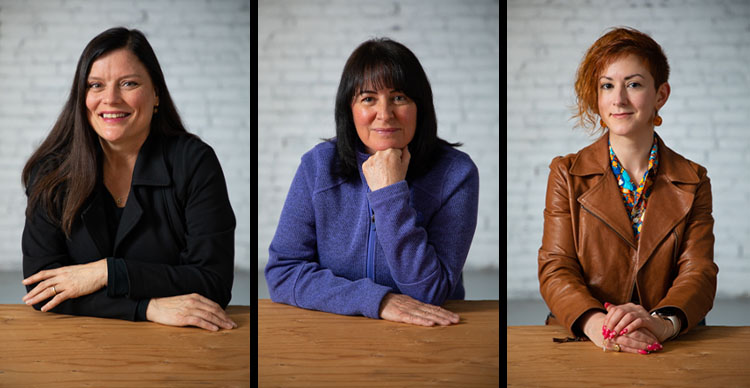 VFS’s Writing faculty consists of active industry writers – the best at their craft in film, television, and games!
What are you most looking forward to in the Scripted Lab Series? How do you see this opportunity impacting your career or next steps as a writer?
LF: I’ll try not to fan girl too hard, but the showrunner, Floyd Kane, is an amazing artist. As a producer and writer, he’s worked on all sorts of projects: documentaries, children’s shows, procedurals, horror, dramatic features, sketch comedy. I love the honest and effortless intersectionality of that series.
I intend to stay in Vancouver, so the PSP lab is one of the very few ways for a local to get into a writer’s room. The lab gives me the opportunity to meet important folk in the industry, collaborate with talented emerging artists, be mentored by a local pro and pitch my own project to networks. There’s also the possibility that this will give us our first professional credit if Floyd’s show gets picked up.
BK: I see the Scripted Series Lab as an important milestone that bridges what I learned at VFS with the next stage of my career as a professional TV writer. After graduating from VFS, I balanced my day job as a high school English and Drama teacher while consistently submitting my work to competitions, fellowships, and film festivals. I’ve been fortunate to attend several industry events due to placements, often at the Quarterfinalist or Semifinalist level, but the PSP Scripted Series Lab feels like my first truly substantial professional opportunity. It offers a rare chance to experience what it’s like to work in a writers’ room, and I hope it will further instill the discipline of a working writer while strengthening my ability to collaborate with other writers.
What current writers’ room would be a dream to join?
LF: I’m a big fan of Susin Nielsen. I’d love to be in the room with her. Family Law was such a clever idea. She wrapped a legal procedural around a family drama which allowed her to play in all sorts of directions. She’s also a lovely person. Small Achievable Goals would be hilarious to work on. If we’re talking dreams here, I’d love to be in the writer’s room for Blue Lights. The ultimate goal though is to show run my own series, Ends Meat.
BK: If Apple TV’s Pachinko is greenlit for a third season, my highly unlikely—but deeply cherished—dream would be to join its writer’s room. I’ve read the novel and have been captivated by Min Jin Lee’s raw authenticity and voice in illuminating the lived experiences of Zainichi Koreans in Japan. As a self-proclaimed history nerd with a strong desire to tell stories rooted in my Korean-Canadian identity, I deeply admire the series’ dedication to honest, compassionate storytelling. To contribute to a writer’s room that values collaboration and authenticity in portraying Korean immigrant histories would be an extraordinary honor.
What advice do you have for aspiring writers?
LF: Aspiring writers: I would recommend having your script read out loud by professional/union actors as part of your process. Don’t go into your shoot having never heard your script out loud. Most actors are insightful and give you valuable notes. They can also connect you to directors and crew and producers. Don’t be afraid of them. Don’t kill your work with amateurs by assuming you can’t get a seasoned cast, you’d be surprised. There’s a bit of paperwork going through UBCP/ACTRA, but it’s worth it. A lot of actors will work in-kind or for very little a day to encourage new talent. Also, please write diversely. Put it into your script: names, dialogue, food, relationships, situations. When you write outside of your lived experience write with a consult or co-write.
BK: I’m not sure my advice would be helpful, given that I still consider myself an aspiring writer—but let me immediately contradict myself and say this: I am a writer. And if you’re reading this and think of yourself as an “aspiring” writer, I want to say the same to you. As long as you’re writing, you are a writer. I think that mindset shift is crucial.
I very much operate on a “fake it till you make it” philosophy. Whenever I open Final Draft or a Google Doc to write or brainstorm, I treat myself as a professional writer—someone who’s getting paid to do this work, almost like an actor stepping into a role. That sense of manifestation, imagination, and adopting a professional attitude has genuinely helped me build momentum and turn aspirations into action.